2016年11月17日 星期四

Poems by Carol Ann Duffy


Carol Ann Duffy
Poet
Dame Carol Ann Duffy DBE FRSL is a Scottish poet and playwright. She is Professor of Contemporary Poetry at Manchester Metropolitan University, and was appointed Britain's Poet Laureate in May 2009. Wikipedia
BornDecember 23, 1955 (age 60), Glasgow, United Kingdom
It's always good when women win things in fiction because it tends to be more male-dominated, unlike poetry, which is more equal.
I write quite a lot of sonnets, and I think of them almost as prayers: short and memorable, something you can recite.
Christmas is taken very seriously in this household. I believe in Father Christmas, and there's no way I'd do anything to undermine that belief.
達菲(Carol Ann Duffy)這樣說:「愛是天分,世界是愛的隱喻。」


Poems by Carol Ann Duffy

Ship
Sung
The Look
If I Was Dead
The Scottish Prince
How many sailors to sail a ship?
Safe Sounds
Spell
Havisham
Valentine
Originally
Mrs Midas
Anne Hathaway
War Photographer
The DarkCarol Ann Duffy

Ship
的隱喻。」
In the end, it was nothing more than the toy boat of a boy on the local park’s lake, where I walked with you. But I knelt down to watch it arrive, its white sail shy with amber light, the late sun bronzing the wave that lifted it up, my ship coming in with its cargo of joy.

Carol Ann Duffy


from Rapture (London: Picador, 2005)
Reproduced by permission of the publisher, Pan Macmillan

2016年11月12日 星期六

Laurence Binyon’s poem ‘For the Fallen’ on Armistice Day

‘They shall grow not old, as we that are left grow old'  此句似乎被某詩人"拿來"用在悼"Keats"上
Laurence Binyon’s poem ‘For the Fallen’ on Armistice Day.
http://bit.ly/2fIQM95

View the 'Manuscript of 'For the Fallen' by Laurence Binyon', on the British Library's website.
BL.UK

2016年11月11日 星期五

"Jazz Band in a Parisian Cabaret", "Summer Nights" (1925) "As I Grew Older" by Langston Hughes

Everyman's Library

James Mercer Langston Hughes died in New York City, on this day in 1967 (aged 65).

"Jazz Band in a Parisian Cabaret" by Langston Hughes
Play that thing,
Jazz band!
Play it for the lords and ladies,
For the dukes and counts,
For the whores and gigolos,
For the American millionaires,
And the school teachers
Out for a spree.
Play it,
Jazz band!
You know that tune
That laughs and cries at the same time.
You know it.
May I?
Mais oui.
Mein Gott!
Parece una rumba.
Play it, jazz band!
You've got seven languages to speak in
And then some,
Even if you do come from Georgia.
Can I go home wid yuh, sweetie?
*


"Summer Nights" (1925) by Langston Hughes (1902-1967)
The sounds
Of the Harlem night
Drop one by one into stillness.
The last player-piano is closed.
The last victrola ceases with the
“Jazz Boy Blues.”
The last crying baby sleeps
And the night becomes
Still as a whispering heartbeat.
I toss
Without rest in the darkness,
Weary as the tired night,
My soul
Empty as the silence,
Empty with a vague,
Aching emptiness,
Desiring,
Needing someone,
Something.
I toss without rest
In the darkness
Until the new dawn,
Wan and pale,
Descends like a white mist
Into the court-yard.
*


"As I Grew Older" by Langston Hughes
It was a long time ago.
I have almost forgotten my dream.
But it was there then,
In front of me,
Bright like a sun—
My dream.
And then the wall rose,
Rose slowly,
Slowly,
Between me and my dream.
Rose until it touched the sky—
The wall.
Shadow.
I am black.
I lie down in the shadow.
No longer the light of my dream before me,
Above me.
Only the thick wall.
Only the shadow.
My hands!
My dark hands!
Break through the wall!
Find my dream!
Help me to shatter this darkness,
To smash this night,
To break this shadow
Into a thousand lights of sun,
Into a thousand whirling dreams
Of sun!
*
From the publication of his first book in 1926, Langston Hughes was hailed as the poet laureate of black America, the first to commemorate the experience of African Americans in a voice that no reader, black or white, could fail to hear. Lyrical and pungent, passionate and polemical, this volume is a treasure-an essential collection of the work of a poet whose words have entered our common language.

2016年11月10日 星期四

Cordial Words, easy street


 英文對語?:  Cordial Words,  easy street 安逸街的熱忱會

Cordial Words After Trump and Obama Meet at White House


Cordial Words After Trump and Obama Meet at White House
The Transition BeginsPresident Obama said he and President-elect Donald J. Trump had an excellent and wide-ranging conversation at the White House on Thursday.
90-Minute Meeting Was a ‘Great Honor,’ Says President-Elect
By JULIE HIRSCHFELD DAVIS


703 Easy Street by The Collapsable Hearts Club ft. Jim Biano & Petra ...

https://www.youtube.com/watch?v=JoQ4GidQP-k
4 days ago - Uploaded by VirulentViper
This song plays while Daryl is sleeping in his cell before being woken up by Easy Street blaring. It also plays ...
You can check out the full lyrics to "Easy Street," below — and if you're not done hating yourself, you can also listen to the song. 
We're on easy street
And it feels so sweet
'Cause the world is 'bout a treat
When you're on easy street
And we're breaking out the good champagne
We're sitting pretty on the gravy train
And when we sing every sweet refrain repeats
Right here on easy street

It's our moment in the sun
And it's only just begun
It's time to have a little fun
We're inviting you to come and see why you should be
On easy street
Yeah, we got a front row seat
O, to a life that can't be beat
Right here on easy street
It's our moment in the sun
And it's only just begun
It's time to have a little fun
And we're inviting you to come and see why you should be
On easy street
Yeah, we got a front row seat
O, to a life that can't be beat
Right here on easy street

'Cause the world is 'bout a treat
When you're on easy street

'Cause the world is 'bout a treat
When you're on easy street


easy street 喬治高"家在安逸街":easy street喻"豐衣足食、生活優裕的境界。"


cordial  熱忱的
cordial
ˈkɔːdɪəl/
adjective
  1. 1.
    warm and friendly.
    "the atmosphere was cordial and relaxed"
  2. 2.
    strongly felt.
    "I earned his cordial loathing"
noun
  1. 1.
    BRITISH
    a sweet fruit-flavoured drink.
    "wine cups and fruit cordials"
    synonyms:squashcrushconcentrate
    "I often drank water with fruit cordial"
  2. 2.
    a pleasant-tasting medicine.

2016年11月5日 星期六

"Mandalay" by Rudyard Kipling

"Mandalay" by Rudyard Kipling
By the old Moulmein Pagoda, lookin' eastward to the sea,
There's a Burma girl a-settin', and I know she thinks o' me;
For the wind is in the palm-trees, and the temple-bells they say:
"Come you back, you British soldier; come you back to Mandalay!"
Come you back to Mandalay,
Where the old Flotilla lay:
Can't you 'ear their paddles chunkin' from Rangoon to Mandalay?
On the road to Mandalay,
Where the flyin'-fishes play,
An' the dawn comes up like thunder outer China 'crost the Bay!
'Er petticoat was yaller an' 'er little cap was green,
An' 'er name was Supi-yaw-lat -- jes' the same as Theebaw's Queen,
An' I seed her first a-smokin' of a whackin' white cheroot,
An' a-wastin' Christian kisses on an 'eathen idol's foot:
Bloomin' idol made o'mud --
Wot they called the Great Gawd Budd --
Plucky lot she cared for idols when I kissed 'er where she stud!
On the road to Mandalay . . .
When the mist was on the rice-fields an' the sun was droppin' slow,
She'd git 'er little banjo an' she'd sing "~Kulla-lo-lo!~"
With 'er arm upon my shoulder an' 'er cheek agin' my cheek
We useter watch the steamers an' the ~hathis~ pilin' teak.
Elephints a-pilin' teak
In the sludgy, squdgy creek,
Where the silence 'ung that 'eavy you was 'arf afraid to speak!
On the road to Mandalay . . .
But that's all shove be'ind me -- long ago an' fur away,
An' there ain't no 'busses runnin' from the Bank to Mandalay;
An' I'm learnin' 'ere in London what the ten-year soldier tells:
"If you've 'eard the East a-callin', you won't never 'eed naught else."
No! you won't 'eed nothin' else
But them spicy garlic smells,
An' the sunshine an' the palm-trees an' the tinkly temple-bells;
On the road to Mandalay . . .
I am sick o' wastin' leather on these gritty pavin'-stones,
An' the blasted Henglish drizzle wakes the fever in my bones;
Tho' I walks with fifty 'ousemaids outer Chelsea to the Strand,
An' they talks a lot o' lovin', but wot do they understand?
Beefy face an' grubby 'and --
Law! wot do they understand?
I've a neater, sweeter maiden in a cleaner, greener land!
On the road to Mandalay . . .
Ship me somewheres east of Suez, where the best is like the worst,
Where there aren't no Ten Commandments an' a man can raise a thirst;
For the temple-bells are callin', an' it's there that I would be --
By the old Moulmein Pagoda, looking lazy at the sea;
On the road to Mandalay,
Where the old Flotilla lay,
With our sick beneath the awnings when we went to Mandalay!
On the road to Mandalay,
Where the flyin'-fishes play,
An' the dawn comes up like thunder outer China 'crost the Bay!
*
Beloved for his fanciful and engrossing children’s literature, controversial for his enthusiasm for British imperialism, Rudyard Kipling remains one of the most widely read writers of Victorian and modern English literature. In addition to writing more than two dozen works of fiction, including Kim and The Jungle Book, Kipling was a prolific poet, composing verse in every classical form from the epigram to the ode. Kipling’s most distinctive gift was for ballads and narrative poems in which he drew vivid characters in universal situations, articulating profound truths in plain language. Yet he was also a subtle, affecting anatomist of the human heart, and his deep feeling for the natural world was exquisitely expressed in his verse. He was shattered by World War I, in which he lost his only son, and his work darkened in later years but never lost its extraordinary vitality. All of these aspects of Kipling’s poetry are represented in this selection, which ranges from such well-known compositions as “Mandalay” and “If” to the less-familiar, emotionally powerful, and personal epigrams he wrote in response to the war. READ more here: http://knopfdoubleday.com/book/93146/kipling-poems/

2016年11月2日 星期三

"Epitaph on a Tyrant" by W. H. Auden

"Epitaph on a Tyrant" by W. H. Auden
Perfection, of a kind, was what he was after,
And the poetry he invented was easy to understand;
He knew human folly like the back of his hand,
And was greatly interested in armies and fleets;
When he laughed, respectable senators burst with laughter,
And when he cried the little children died in the streets.

“Election Day, November, 1992”;Walt Whitman, “Election Day, November, 1884”


1992年的美國總統選舉日,我與阿擘回他的母校加州大學UC Davis ,住在附近的民宿。由於是假日,靜得"不可思議",天地悠悠,我在附近的草地走走.....
當年在杜邦公司"服務",當時已知公司要將我們整個事業部門"賣出" (也許4億美元),有點傷心:因為我將台灣的工廠和市場單位"轉型",不過,那只是戰爭中的一場地方戰役......所以決定休年假。.....

The United States presidential election of 1992 was the 52nd quadrennial presidential election. It was held on Tuesday, November 3, 1992. There were three major candidates: Incumbent Republican President George H. W. Bush; Democratic Arkansas Governor Bill Clinton, and independent Texas businessman Ross Perot.

United States presidential election, 1992 - Wikipedia

https://en.wikipedia.org/wiki/United_States_presidential_election,_1992


Walt Whitman, “Election Day, November, 1884”

November 4, 2014 | by 
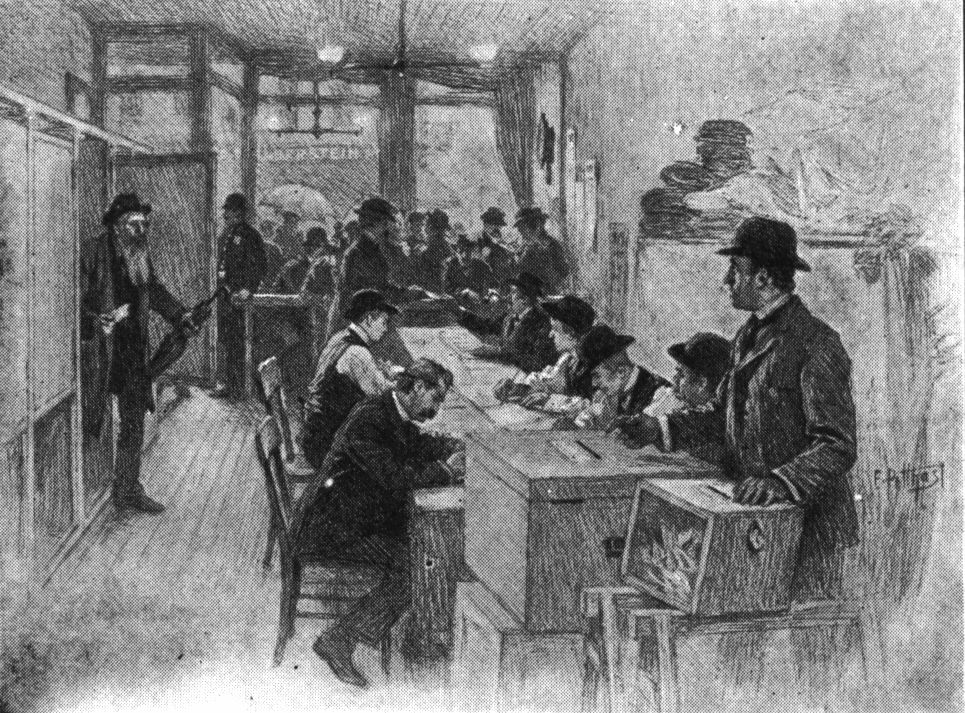
1900_New_York_polling_place
A polling place in New York ca. 1900.
A reminder: Walt Whitman really, really liked Election Day. Nothing could quicken the man’s pulse like a good showing at the polls.
As “Election Day, November, 1884” has it, he preferred the spectacle of democracy—the “ballot-shower from East to West”—to any of our nation’s natural wonders, including, but not limited to, Niagara Falls, the Mississippi River, Yosemite, Yellowstone, the Great Lakes … you name it, Whitman thought the vote was better than it. (You’d think someone could’ve sold him on the Rockies, at least.) One can imagine a latter-day Whitman passing up a trip to the Grand Canyon and instead hunkering down at the TV, flipping anxiously from network to network as the precincts begin to report, wringing his hands. Not, mind you, that he would have any particular stake in the outcome; he’d just be along for the great democratic ride, clucking his tongue at the gerrymanderers of the world.
(If you need an antidote for all this unalloyed patriotism, try Charles Bernstein’s “On Election Day,” which contains, among many excellent lines, “The air is putrid, red, interpolating, quixotic, torpid, vulnerable, on election day.” I know which poet would get my vote.)
If I should need to name, O Western World, your powerfulest
         scene and show,
’Twould not be you, Niagara—nor you, ye limitless prairies—nor
         your huge rifts of canyons, Colorado,
Nor you, Yosemite—nor Yellowstone, with all its spasmic geyser-
         loops ascending to the skies, appearing and disappearing,
Nor Oregon’s white cones—nor Huron’s belt of mighty lakes—
         nor Mississippi’s stream:
—This seething hemisphere’s humanity, as now, I’d name— the 
still small voice vibrating—America’s choosing day,
(The heart of it not in the chosen—the act itself the main, the
         quadriennial choosing,)
The stretch of North and South arous’d—sea-board and inland
         —Texas to Maine—the Prairie States—Vermont, Virginia,
         California,
The final ballot-shower from East to West—the paradox and con-
         flict,
The countless snow-flakes falling—(a swordless conflict,
Yet more than all Rome’s wars of old, or modern Napoleon’s:)
         the peaceful choice of all,
Or good or ill humanity—welcoming the darker odds, the dross:
—Foams and ferments the wine? it serves to purify—while the
         heart pants, life glows:
These stormy gusts and winds waft precious ships,
Swell’d Washington’s, Jefferson’s, Lincoln’s sails.