2016年3月3日 星期四

DH Lawrence:Sons and Lovers (1992);poem, ‘The Collier’s Wife’,


Author DH Lawrence died ‪#‎onthisday‬ in 1930.
Born in the small mining town of Eastwood in Nottinghamshire, Lawrence won a scholarship to Nottingham High School at the age of 12, and went on to study at the University College of Nottingham in 1906. This poem, ‘The Collier’s Wife’, contains dialect words and grammar and captures the local pronunciation of his native county.http://bit.ly/1oP8zy4

2016年3月2日 星期三

Such stuff as dreams are made on


To mark the 400th anniversary of William Shakespeare’s death, we asked leading actors to perform key speeches from his plays. Here, David Threlfall speaks Prospero’s lines from The Tempest , contemplating the end of life


-1:10


《暴風雨》旁述對白,朱生豪/梁實秋譯本Selected texts from ...

https://zh-tw.facebook.com/.../暴風雨旁述對白朱生豪...
Translate this page
我們的狂歡已經終止了。我們的這一些演員們,我曾經告訴過你,原是一群精靈都已化成淡煙而消散了。如同這段幻景虛妄的構成一樣,入雲的樓閣,瑰偉的宮殿,莊嚴  ...


朱生豪 (1912-1944)
普洛士丕羅(舊密蘭公爵) 

我們的狂歡已經終止了。我們的這一些演員們,我曾經告訴過你,原是一群精靈都已化成淡煙而消散了。如同這段幻景虛妄的構成一樣,入雲的樓閣,瑰偉的宮殿,莊嚴的廟堂,甚至地球自身,以及地球上所有的一切,都將同樣消散,就像這一場幻景,連一點煙雲的影子都不曾留下。我們都是夢中的人物,我們的一生是在酣睡之中。
-----

梁實秋 (1903-1987)
普洛斯帕羅(米蘭的合法的公爵)
我們的遊戲現在完了。我們的這些演員,我已說過,原是一些精靈,現在化成空氣,稀薄的空氣:頂着雲霄的高樓,富麗堂皇的宮殿,莊嚴的廟宇,甚至這地球本身,對了,還有地球上的一切,將來也會像這毫無根基的幻象一般的消逝,並同也會和這剛幻滅的空虛的戲景一樣不留下一點煙痕。我們的本質原來也和夢的一般,我們的短促的一生是被圜繞在睡眠裏面。

Such stuff as dreams are made on

Prospero:
Our revels now are ended. These our actors,
As I foretold you, were all spirits, and
Are melted into air, into thin air:
And like the baseless fabric of this vision,
The cloud-capp'd tow'rs, the gorgeous palaces,
The solemn temples, the great globe itself,
Yea, all which it inherit, shall dissolve,
And, like this insubstantial pageant faded,
Leave not a rack behind. We are such stuff
As dreams are made on; and our little life
Is rounded with a sleep.
The Tempest Act 4, scene 1, 148–158

http://www.enotes.com/shakespeare-quotes/we-such-stuff-dreams-made


2016年3月1日 星期二

"Good-Night" by Percy Bysshe Shelley (1792-1822)

"Good-Night" by Percy Bysshe Shelley
Good-night? ah! no; the hour is ill
Which severs those it should unite;
Let us remain together still,
Then it will be good night.
How can I call the lone night good,
Though thy sweet wishes wing its flight?
Be it not said, thought, understood --
Then it will be -- good night.
To hearts which near each other move
From evening close to morning light,
The night is good; because, my love,
They never say good-night.
*
Percy Bysshe Shelley (1792-1822) was perhaps the most intellectually adventurous of the great Romantic poets. A classicist, a headlong visionary, a social radical, and a poet of serene artistry with a lyric touch second to none, Shelley personified the richly various—and contradictory—energies of his time. This compact yet comprehensive collection showcases all the extraordinary facets of Shelley’s art. From his most famous lyrical poems (“Ozymandias,” “The Cloud”) to his political and philosophical works (”The Mask of Anarchy,” “Hymn to Intellectual Beauty”) to excerpts from his remarkable dramatic and narrative verses (“Alastor,” “Prometheus Unbound”), Shelley’s words gave voice to English romanticism's deepest aspirations.

2016年2月27日 星期六

AMONG SCHOOL CHILDREN by W B Yeats

名詩。卞之琳等人有翻譯。

2014.6.30 當"督學"的詩人。卞之琳有漢譯。


Among School Children
 gif
William Butler Yeats (from The Tower, 1928)


AMONG SCHOOL CHILDREN
I
I WALK through the long schoolroom questioning;
A kind old nun in a white hood replies;
The children learn to cipher and to sing,
To study reading-books and histories,
To cut and sew, be neat in everything
In the best modern way -- the children's eyes
In momentary wonder stare upon
A sixty-year-old smiling public man.
II
I dream of a Ledaean body, bent
Above a sinking fire. a tale that she
Told of a harsh reproof, or trivial event
That changed some childish day to tragedy --
Told, and it seemed that our two natures blent
Into a sphere from youthful sympathy,
Or else, to alter Plato's parable,
Into the yolk and white of the one shell.
III
And thinking of that fit of grief or rage
I look upon one child or t'other there
And wonder if she stood so at that age --
For even daughters of the swan can share
Something of every paddler's heritage --
And had that colour upon cheek or hair,
And thereupon my heart is driven wild:
She stands before me as a living child.
IV
Her present image floats into the mind --
Did Quattrocento finger fashion it
Hollow of cheek as though it drank the wind
And took a mess of shadows for its meat?
And I though never of Ledaean kind
Had pretty plumage once -- enough of that,
Better to smile on all that smile, and show
There is a comfortable kind of old scarecrow.
V
What youthful mother, a shape upon her lap
Honey of generation had betrayed,
And that must sleep, shriek, struggle to escape
As recollection or the drug decide,
Would think her Son, did she but see that shape
With sixty or more winters on its head,
A compensation for the pang of his birth,
Or the uncertainty of his setting forth?
VI
Plato thought nature but a spume that plays
Upon a ghostly paradigm of things;
Soldier Aristotle played the taws
Upon the bottom of a king of kings;
World-famous golden-thighed Pythagoras
Fingered upon a fiddle-stick or strings
What a star sang and careless Muses heard:
Old clothes upon old sticks to scare a bird.
VII
Both nuns and mothers worship images,
But those the candles light are not as those
That animate a mother's reveries,
But keep a marble or a bronze repose.
And yet they too break hearts -- O presences
That passion, piety or affection knows,
And that all heavenly glory symbolise --
O self-born mockers of man's enterprise;
VIII
Labour is blossoming or dancing where
The body is not bruised to pleasure soul.
Nor beauty born out of its own despair,
Nor blear-eyed wisdom out of midnight oil.
O chestnut-tree, great-rooted blossomer,
Are you the leaf, the blossom or the bole?
O body swayed to music, O brightening glance,
How can we know the dancer from the dance?

2016年2月24日 星期三

LEDA AND THE SWAN

LEDA AND THE SWAN
A SUDDEN blow: the great wings beating still
Above the staggering girl, her thighs caressed
By the dark webs, her nape caught in his bill,
He holds her helpless breast upon his breast.
How can those terrified vague fingers push
The feathered glory from her loosening thighs?
And how can body, laid in that white rush,
But feel the strange heart beating where it lies?
A shudder in the loins engenders there
The broken wall, the burning roof and tower
And Agamemnon dead.
Being so caught up,
So mastered by the brute blood of the air,
Did she put on his knowledge with his power
Before the indifferent beak could let her drop?

"The 25 greatest British novels"

Do you agree?
BBC Culture contributor Jane Ciabattari polled 82 book critics from outside the UK, to pick Britain’s best novels ever – this is what some had to say about the top choices.
BBC.COM|由 JANE CIABATTARI 上傳

2016年2月23日 星期二

Autumn Rain by DH Lawrence


Poem of the week: Autumn Rain by DH Lawrence


Intensely alive to the details of the natural world, Lawrence here combines the energy of his free verse with formal invention
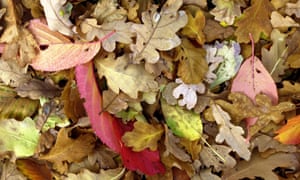
Fallen leaves in autumn. Photograph: Tim Ockenden/PA


Carol Rumens

Monday 22 February 2016 11.00 GMT


Autumn Rain


The plane leaves
fall black and wet
on the lawn;

the cloud sheaves
in heaven’s fields set
droop and are drawn

in falling seeds of rain;
the seed of heaven
on my face

falling — I hear again
like echoes even
that softly pace

heaven’s muffled floor,
the winds that tread
out all the grain


Sign up to our Bookmarks newsletter

Read more

of tears, the store
harvested
in the sheaves of pain

caught up aloft:
the sheaves of dead
men that are slain

now winnowed soft
on the floor of heaven;
manna invisible

of all the pain
here to us given;
finely divisible
falling as rain.
Advertisement


Autumn Rain was first published in the Egoist, under the editorship of Dora Marsden and Harriet Shaw Weaver, in February 1917. Lawrence included it in the section headed Unrhyming Poems in his Collected volume, a minor point of interest, as his two categories Rhyming and Unrhyming aren’t stringently enforced. The positioning, though, helps the reader see what is gained and what is lost in Lawrence’s revisionist poetics, as he moves from a tightly lyrical, and arguably symbolist, mode of expression to predominantly free verse andWhitmanesque spontaneity.

His free verse poems vary in achievement: at their best, they capture the physical world with an unsurpassed intensity and vigour. Yet I can’t imagine anyone thinking Autumn Rain would be a more effective poem had Lawrence sacrificed his ingenious rhyme-scheme and adopted a more rhetorical or oratorical tone. The vices of copybook traditionalism are quietly transformed: for instance, the inversion in “echoes even” sounds out the trochaic regularity of repeated footsteps. The further possibility of a double meaning for “even” turns the whole device into a masterstroke.

Christian “resurrection theology” appears to inform the harvest symbolism but is under-lit by visions of less supernatural phenomena. The sky, “heaven’s muffled floor”, is the threshing floor where “winds” winnow the harvest of the dead. Despite the “manna” reference, there’s no mention of God, and “heaven” remains uncapitalised. We’re left with an impression of natural recycling rather than divine intervention, even if the descriptive tone is more consolatory than might be considered realistic.

The rhyme scheme makes itself felt in the second stanza. It’s a simple scheme at first. Stanzas one and two rhyme abc, abc, and that pattern, using a new set of rhymes, continues until stanza seven, where the middle line reproduces, in “dead,” the rhyme heard twice before (“tread”, “harvested”). In stanza eight, a new rhyme occurs at the end of its third line (“invisible”). Here, by the way, there’s another apparent adjective-noun inversion, “manna invisible”. It’s an illusion, of course: Lawrence, somewhat awkwardly, but not ineffectively, continues the sentence: “manna invisible // of all the pain …” so readers must re-think the grammatical position of “invisible”. The final quatrain recalls a rhyme first occurring in the “rain” of stanza three, picks up a near-rhyme with “heaven” and “even” in the form of “given”, and partners “invisible” from the previous stanza with “divisible”. There’s a lot more going on in terms of sonic effect, of course, than the “sound” of rhyme: “fall”, “drawn”, “falling”; “sheaves”, “fields”, “seeds” etc. Such assonance is subtly mimetic, never merely decorative. The “aw” of the long “a”, for instance, contrasts with the harshness of sound in “pain” and “slain”, enabling us to hear the imagined transformation of suffering occasioned by the soft, encapsulating autumn rainfall.

Should it be read as a war poem? There might be a connection with the short poem Bombardment, in whose four tercets something more dreadful and dramatic than rain descends from the sky. References to “sheaves of pain” and “sheaves of the dead / men that are slain” and a slight similarity of form may be clues. The final quatrain of Autumn Rain, however, suggests a more inclusive reach, envisioning redemption by metamorphosis for “all the pain / here to us given …”A